
A nation shaped by football
For much of the 20th century, Yugoslavia existed as a political experiment held together by compromise, ideology, and fragile unity. Football became one of the few shared cultural spaces where those differences could coexist. On the pitch, Yugoslavia was not required to resolve its internal contradictions. It simply had to play. And when it did, it produced football of rare imagination, technical skill, and intelligence.
From its earliest international appearances, Yugoslavia established a reputation as a nation capable of challenging anyone. It was not built on physical dominance or tactical rigidity, but on fluid movement, comfort on the ball, and creative freedom. This identity would remain constant even as the country itself changed names, borders, and political systems.
Yet for all its talent, Yugoslavia was never stable. Football mirrored the country’s structure: brilliant, diverse, and permanently vulnerable to collapse.
Early foundations and shared identity
Football arrived in Yugoslavia through ports, railways, and universities, spreading unevenly across regions. Croatia and Slovenia absorbed Central European influences, Serbia developed a more direct style, while Bosnia and Herzegovina contributed flair and improvisation. Rather than flatten these differences, Yugoslav football allowed them to coexist.
The national team became a rare symbol of shared pride. Players from different republics wore the same shirt and, for ninety minutes, represented something larger than themselves. Success reinforced the illusion that unity was possible. Defeats, however, often reopened questions that football could not answer.
By the post-war period, Yugoslavia had established itself as a consistent tournament presence. Olympic gold in 1960 and regular deep runs in major competitions confirmed its place among Europe’s elite. Still, there was a sense that Yugoslavia should have achieved more.
Talent without fulfilment
Yugoslavia’s squads were routinely filled with players admired across Europe. Scouts spoke of technical training that encouraged intelligence over obedience. Young players were trusted to make decisions rather than follow strict instructions. This produced footballers comfortable under pressure and unafraid of expression.
However, this freedom came at a cost. Tactical discipline was sometimes lacking. Matches slipped away through emotional lapses or internal tension. Yugoslavia were admired, but rarely feared in the way serial winners were.
This imbalance between ability and outcome became a defining feature. Yugoslavia did not fail because of a lack of talent. It failed because cohesion was always temporary.
The 1980s generation emerges
By the mid-1980s, Yugoslavia began producing what many consider its most gifted generation. The youth teams dominated international tournaments, culminating in the 1987 World Youth Championship victory. The squad was filled with future stars who would go on to shape European football.
What made this generation special was balance. Creativity existed alongside tactical maturity. Defenders were comfortable building play, midfielders controlled tempo, and attackers combined flair with efficiency. For once, Yugoslavia appeared to possess both beauty and structure.
At club level, Yugoslav teams became increasingly competitive in European competitions. Domestic football thrived, and the national team entered tournaments with genuine expectations rather than hope.
A team approaching its peak
As the 1990s approached, Yugoslavia seemed ready to convert promise into dominance. Qualification campaigns were convincing. Performances were confident. The national team was no longer an entertaining outsider, but a legitimate contender.
Euro 1992 was supposed to be the culmination of this cycle. The squad combined experience and youth, intelligence and aggression. On paper, it rivalled any team in Europe. For the first time, Yugoslavia was expected not just to compete, but to win.
Instead, the team never played a single match.
Politics overtakes football
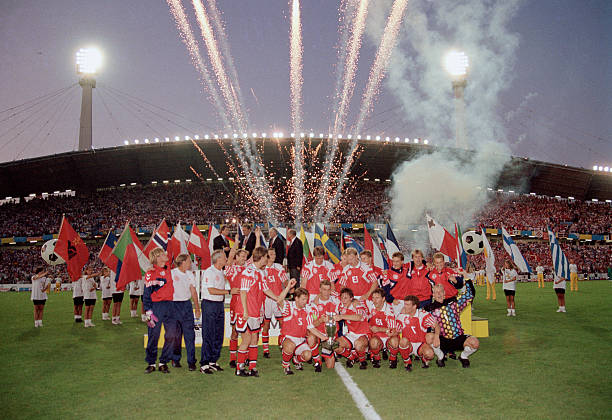
While Yugoslav football reached its peak, the country itself was unraveling. Nationalism replaced ideology, and political rhetoric hardened across the republics. When Yugoslavia was disqualified from Euro 1992 due to international sanctions, Denmark was invited as a late replacement and went on to win the tournament. The triumph underlined what Yugoslavia had lost, as a generation good enough to contend for the title never took the field.
The generation that never played
What makes this Yugoslav generation unique is not just its quality, but its absence. Other great teams are remembered for victories or defeats. This one is remembered for silence.
Players were scattered across newly formed national teams. Careers continued, often successfully, but something essential was lost. No successor nation inherited the full weight of Yugoslavia’s talent pool. Each gained pieces, none gained the whole.
The question of what this team could have achieved remains unanswered. It exists only in hypothetical lineups and fragmented memories.
Fragmentation and aftermath
The breakup of Yugoslavia did not end football in the region, but it fundamentally altered it. New national teams emerged with pride and urgency, yet lacked the depth Yugoslavia once possessed.
Some successor states achieved remarkable success, proving the strength of the footballing culture. Others struggled under limited resources and political instability. All shared the same origin, but none replaced the original.
Yugoslavia’s disappearance also ended a particular style of football. The balance between creativity and collective intelligence became harder to sustain in smaller systems.
Memory, nostalgia, and myth
Today, Yugoslavia occupies a unique space in football memory. It is often idealised as a lost golden age, a nation that played football the right way. This nostalgia sometimes smooths over internal conflicts and failures.
Yet the myth exists because the talent was real. Players produced by Yugoslav football continued to influence the game long after the country vanished. Coaches, playmakers, and tacticians carried its ideas into new environments.
The national team may have disappeared, but its footballing philosophy survived in fragments.
Why this generation still matters
The story of Yugoslavia’s vanished generation is not simply tragic. It is instructive. It shows how football can unite without resolving deeper divisions, and how talent alone is never enough.
Yugoslavia reminds us that teams are not just collections of players. They are reflections of political stability, shared identity, and collective belief. When those foundations collapse, even the most gifted generation can disappear without leaving a record.
In football history, few teams are remembered for what they never did. Yugoslavia’s final generation remains one of them.

 By
By