
A club between leagues
CD Logroñés never belonged to the grand narratives of Spanish football. It did not represent a powerful region, a political movement, or a wealthy patron. Instead, it existed quietly on the margins, a club from La Rioja that briefly reached the highest level before disappearing just as discreetly. Its story is not one of scandal or sudden catastrophe, but of gradual overreach, fragile survival, and an ending so subdued that much of Spain barely noticed.
For nearly a decade, Logroñés lived among the elite. It hosted the biggest clubs in the country, survived year after year against the odds, and built an identity rooted in resistance rather than ambition. Central to that identity were its stadiums, particularly Las Gaunas, which became both a symbol of achievement and, eventually, a reminder of what had been lost.
Origins in La Rioja
Founded in 1940, CD Logroñés represented a city better known for wine than football. For decades, the club occupied the lower tiers of Spanish football, drifting between the second and third divisions with little national attention. Ambition was limited by geography, population, and finances. Logroño was a modest city, and its football club reflected that reality.
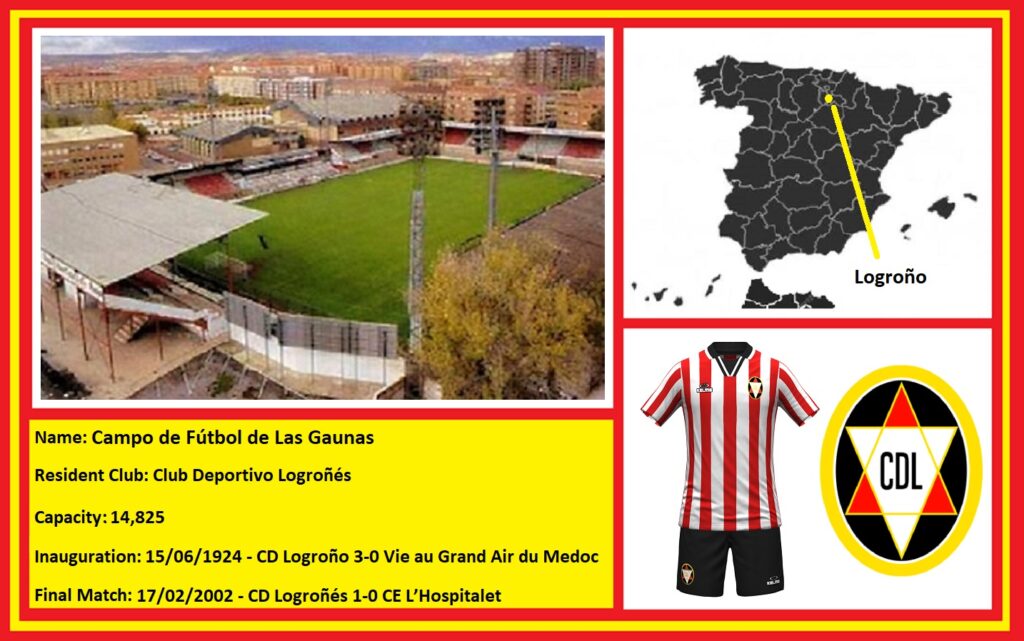
The club’s early home was the original Estadio Las Gaunas, inaugurated in 1924 and shared at various points with other local sides. By the time Logroñés made it their permanent home, the stadium had already become part of the city’s identity. It was basic, enclosed, and intimidating in its own way, with supporters close to the pitch and little separation between players and crowd.
Las Gaunas was never glamorous, but it suited the club perfectly. It was a stadium built for survival, not spectacle.
Promotion and a place among giants
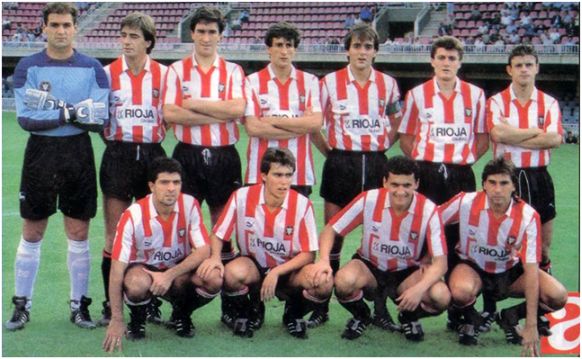
In 1987, CD Logroñés achieved promotion to La Liga for the first time in its history. It was not the result of dominance or heavy investment, but of steady accumulation and well-timed performances. Promotion transformed the club overnight. Logroñés was suddenly sharing a league with Barcelona, Real Madrid, and Atlético Madrid.
The original Las Gaunas became a La Liga stadium almost by accident. Capacity hovered around 16,000, facilities were limited, and the ground lacked the polish of larger venues. Yet it quickly gained a reputation as one of the most uncomfortable away trips in Spain. Visiting teams faced narrow margins, a tight pitch, and a hostile atmosphere that often neutralised technical superiority.
Against expectations, Logroñés stayed up. Then it stayed up again. What followed was an extraordinary run of nine consecutive seasons in La Liga between 1987 and 1996. For a club of its size, this longevity bordered on the improbable.
Life inside Las Gaunas
Las Gaunas was central to Logroñés’ identity during its La Liga years. It was here that the club carved out its survival strategy. Matches were tense, physical, and often ugly. Points were won through discipline, organisation, and stubbornness.
The stadium hosted some of the biggest names in world football. Barcelona and Real Madrid visited regularly, bringing global stars to a city unaccustomed to such attention. For supporters, these matches were not about titles or prestige, but validation. Their club belonged, even if only just.
Occasional famous results followed. Draws and narrow wins at Las Gaunas became folklore. These nights mattered intensely to locals, even if they barely registered nationally. The stadium amplified belief, but it also hid growing problems elsewhere.
Living season to season
Despite top-flight status, CD Logroñés never achieved true stability. Each season was approached as a separate survival mission. The squad was constantly rebuilt using short-term contracts, loans, and experienced players nearing the end of their careers. Long-term planning took a back seat to immediate necessity.
Financially, the club walked a tightrope. La Liga television revenue helped, but it was rarely enough. Wages increased, relegation clauses became essential, and debts quietly accumulated. As long as Logroñés stayed in La Liga, the model functioned. The problem was that there was no margin for failure.
Meanwhile, Spanish football was changing rapidly. The financial gap between large and small clubs widened, stadium standards rose, and commercial demands increased. Las Gaunas, once an asset, began to look outdated in a modernising league.
The beginning of the end
Relegation finally arrived in 1996. On sporting merit, it was hardly shocking. Logroñés had flirted with danger for years. What shocked many was how quickly the club unravelled afterwards.
Dropping into the Segunda División exposed the club’s financial fragility. Reduced income collided with top-division wage structures. Attempts to bounce back failed. Within a short period, Logroñés fell again, slipping into the third tier.
Las Gaunas, once a La Liga fortress, became a symbol of decline. Crowds thinned, revenue dried up, and the stadium felt too large for the club’s new reality. Maintenance costs mounted while ambition evaporated.
A new stadium without a club
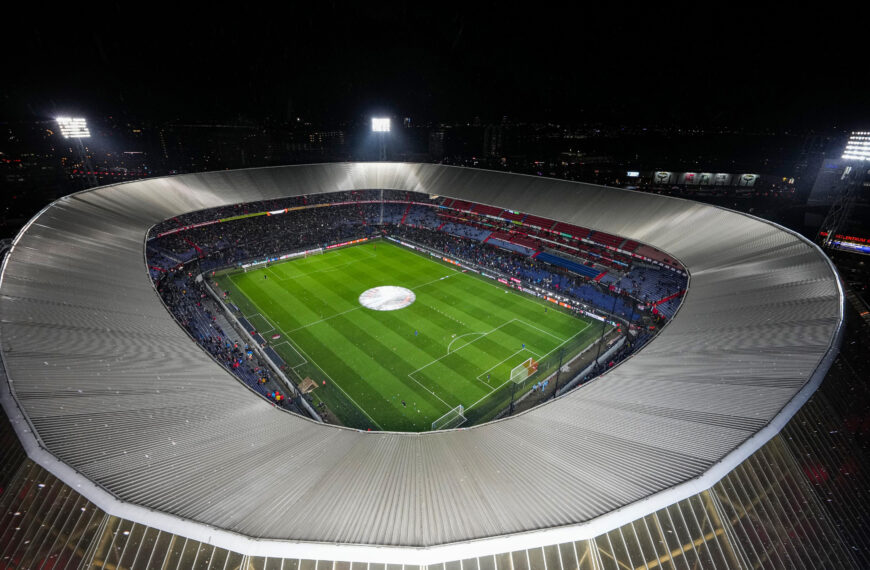
In the early 2000s, the city of Logroño made a decision that would add a cruel layer of irony to the club’s story. The original Las Gaunas was demolished, and a new stadium bearing the same name was built, opening in 2002. The new Estadio Las Gaunas was modern, open, and designed to host professional football for years to come.
CD Logroñés never truly benefited from it.
By the time the new stadium opened, the club was already in deep trouble. Financial chaos, administrative failures, and declining performances meant that Logroñés were unable to establish themselves as tenants worthy of the new ground. The stadium, built with top-flight aspirations, stood as a monument to what the club once was rather than what it had become.
Successor clubs would later play there, but the original Logroñés never made the new Las Gaunas its home in any meaningful sense.
The quiet collapse
Unlike many fallen clubs, CD Logroñés did not collapse in dramatic fashion. There were no national scandals, no headline-grabbing protests, no last-minute rescues. The club rebranded as CD Logroñés SAD, struggled on, and eventually disappeared in 2009.
Debts mounted, players went unpaid, and fixtures became administrative challenges rather than sporting events. When the club finally folded, it did so quietly. Spanish football had moved on. New clubs filled the calendar, and Logroñés became an afterthought.
For supporters, the loss was deeply personal. They had watched La Liga football in their city, hosted global stars, and believed, however briefly, that permanence was possible. What remained were memories tied to a demolished stadium and a new one the club never truly claimed.
A legacy without continuity
Unlike some historic clubs, CD Logroñés did not enjoy a romantic rebirth at a high level. UD Logroñés and other successor entities carried football forward in the city, but they were new stories. The original club’s history ended abruptly, with no direct continuation.
Today, CD Logroñés exists mainly in memory and archive footage. Its La Liga years feel strangely distant, even though they ended relatively recently. Younger fans encounter the name as a curiosity, a reminder that Spanish football once included more regional diversity at the top level.
The old Las Gaunas lives on only in photographs and recollection. The new stadium stands as a reminder of ambition arriving too late.
Why it still matters
CD Logroñés represents a forgotten truth of football. Not every collapse is dramatic. Some clubs simply exhaust themselves trying to belong at a level their structure cannot sustain.
Its story is a warning disguised as nostalgia. Success without foundations can be as dangerous as failure. For smaller clubs, reaching the top often means borrowing from the future, and sometimes that future never arrives.
For nearly a decade, Logroñés stood among Spain’s giants, cheered on inside an ageing stadium that punched far above its weight. That achievement, however fragile, ensures the club’s place in football history, even if the silence that followed almost erased it


 By
By