
A stadium built to redefine sport
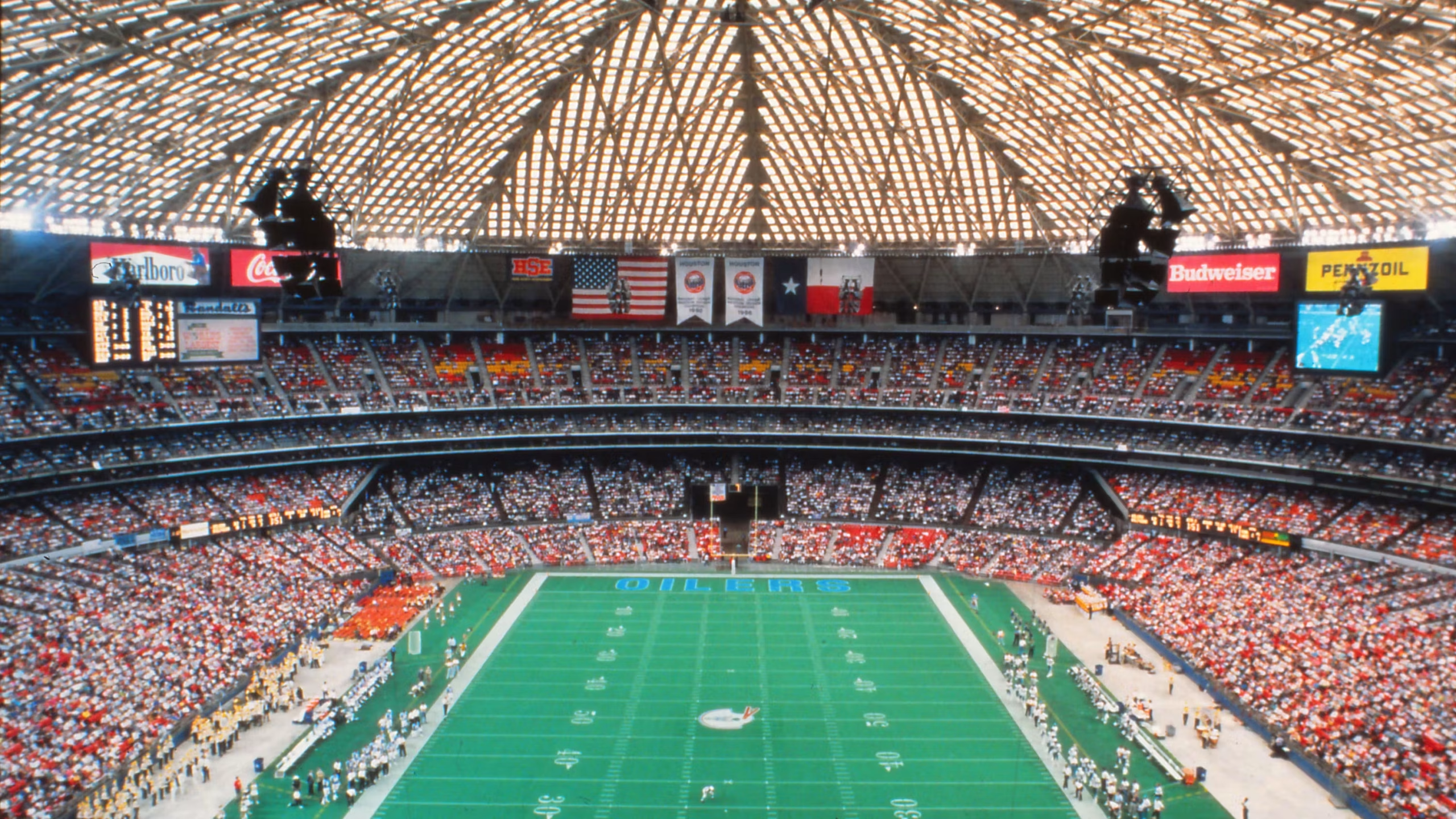
When the Astrodome opened in 1965, it was marketed as the future of sport. Fully enclosed, air-conditioned, and technologically unprecedented, it promised to remove weather, geography, and unpredictability from live events. Known as the “Eighth Wonder of the World,” the stadium was designed primarily for baseball and American football, yet its most revealing role came through a quieter experiment: hosting association football in a country still unsure what to do with the game.
Football arrived at the Astrodome not as tradition, but as possibility. If the world’s game could succeed indoors, under artificial light and controlled conditions, it could be reshaped to fit American expectations. The stadium became a testing ground, not just for a sport, but for an idea.
America searching for a football identity
By the late 1960s and 1970s, football was impossible for the United States to ignore. Globally, the sport dominated culture and commerce. Domestically, it remained peripheral. Earlier professional leagues had collapsed quickly, victims of poor planning and limited public interest.
The North American Soccer League was different. It aimed high, embracing spectacle, star power, and innovation. The NASL did not try to imitate European football. Instead, it tried to translate it. Matches were framed as events, entertainment products designed for television and casual fans.
The Astrodome suited this vision perfectly. It was modern, comfortable, and familiar to American audiences. If football could thrive there, it could thrive anywhere.
Football under a roof
Playing football indoors fundamentally altered the game. Weather disappeared, but so did atmosphere. The artificial turf sped up play, punished poor touch, and reduced tactical subtlety. The ball behaved differently. Matches felt faster, flatter, and less forgiving.
From a broadcast perspective, this consistency was ideal. Games could be scheduled without concern for rain or heat. Lighting was perfect. Sound was controlled. Football became reliable television content.
Yet reliability came at a cost. The Astrodome neutralised football’s natural tension. Without environmental unpredictability or organic crowd build-up, matches struggled to generate emotion. Noise echoed rather than grew. Moments felt isolated rather than connected.
Football was visible, but it did not breathe.
Houston and the NASL gamble
Houston became one of the NASL’s key markets, hosting teams like the Houston Stars and later the Houston Hurricane. Matches at the Astrodome attracted curiosity more than loyalty. Promotional nights boosted attendance, but sustained support proved elusive.
The city already had established sporting identities. Baseball and American football dominated attention. Football was presented as an alternative experience rather than a tribal commitment. Fans came to watch, not to suffer, hope, or belong.
On the pitch, the football mirrored its environment. Direct, physical, and pragmatic, it aligned with American sporting norms. Technical players struggled on artificial turf, while pace and power thrived. The game adapted, but something essential was lost in translation.
Changing the rules to fit the venue
The NASL did not stop at altering surroundings. It changed football itself. Many of these experiments were showcased in venues like the Astrodome.
Draws were removed in favour of shootouts. Offside rules were relaxed. Scoreboards counted down time. Cheerleaders appeared. Music played during stoppages. The aim was constant engagement, constant clarity.
The Astrodome amplified these changes. Its design encouraged segmentation and spectacle. Football was packaged like basketball or ice hockey, sports already deeply embedded in American culture.
For some, this was innovation. For others, it was dilution. Traditionalists recoiled, while promoters argued compromise was necessary for survival.
Stars inside the experiment
While Houston was not home to the NASL’s biggest stars, the Astrodome hosted exhibition matches and high-profile appearances featuring global icons. Pelé, Beckenbauer, and Cruyff all played football in American contexts that felt surreal only years earlier.
Seeing such players under a domed roof symbolised the league’s ambition. Football’s elite were placed inside a controlled, commercialised environment, stripped of the chaos and ritual that defined their careers elsewhere.
For casual fans, it was impressive. For purists, unsettling. Football’s greatest figures felt temporarily removed from their natural habitat.
The limits reveal themselves
Despite investment and innovation, the experiment faltered. The NASL expanded too quickly, overspent, and failed to build sustainable supporter culture. Teams folded or relocated. Houston’s franchises disappeared quietly.
The Astrodome moved on. Football retreated again from the American mainstream, leaving behind a sense of effort without understanding. The stadium had not failed technically. It failed emotionally.
Football cannot be rushed into relevance. History, rivalry, and consequence cannot be manufactured.
Artificial turf and lasting consequences
One of the Astrodome’s unintended legacies was its influence on playing surfaces. Artificial turf spread across American sport long after the NASL collapsed. Football endured it reluctantly.
Players complained of injuries, unnatural ball behaviour, and fatigue. Over time, elite football moved away from such surfaces, reaffirming that not every innovation improves the game.
The Astrodome proved football could be placed anywhere. It also proved that environment shapes meaning.
A neighbour that learned the lesson
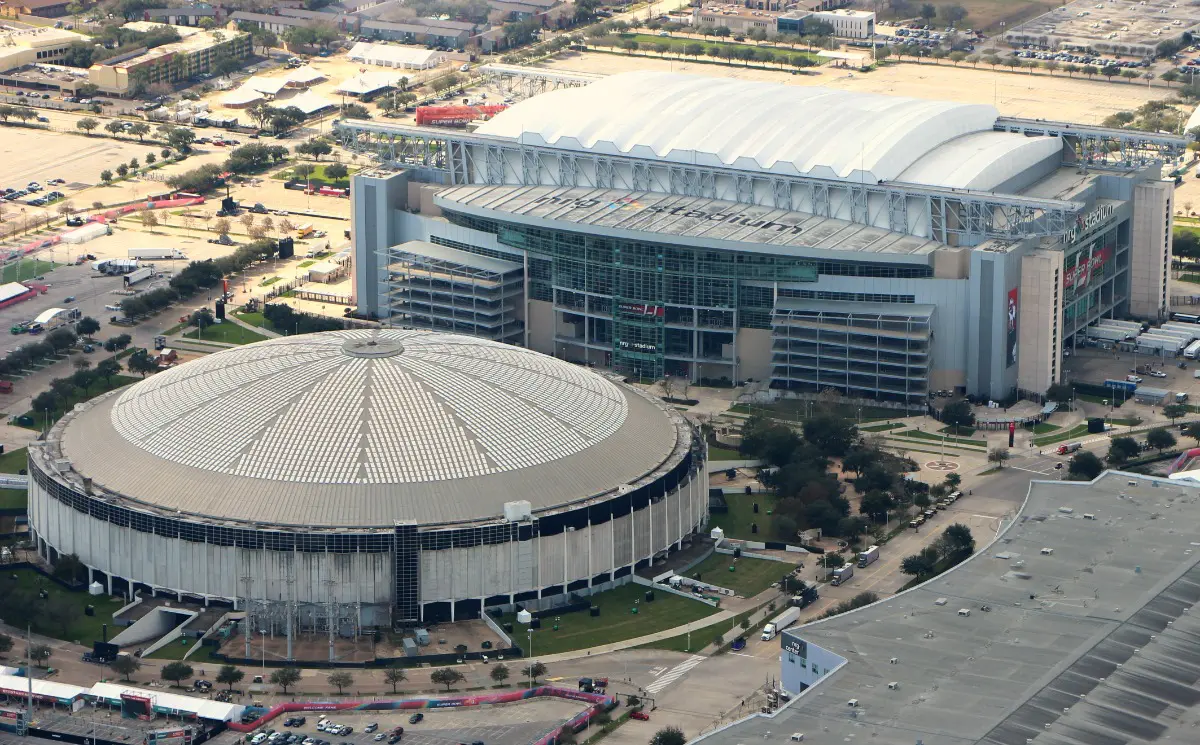
In 2002, NRG Stadium opened directly beside the Astrodome. Modern, openable, and technologically advanced, it replaced the older venue as Houston’s primary sporting stage. The Astrodome, once revolutionary, became obsolete almost overnight.
NRG Stadium represented a different lesson learned. While still large and commercial, it was designed with flexibility rather than control. It could host football without forcing it to adapt completely. The old Astrodome remained sealed, a monument to a future that arrived too early.
Crucially, football’s later growth in the United States would reject the Astrodome model entirely. Major League Soccer favoured soccer-specific stadiums, natural grass, and gradual cultural embedding. The game returned outdoors, to imperfection.
The stadium next door symbolised evolution. The Astrodome symbolised experimentation.
Football indoors, briefly
The Astrodome’s place in football history is not about success or failure alone. It is about limits. It revealed how much football relies on elements that resist control: weather, tension, silence, and disorder.
For a moment, football lived indoors, reshaped to fit a market unfamiliar with patience. It survived the experiment, but it did not belong there.
Today, the Astrodome stands silent beside its successor. Together, the two stadiums tell a story not just of architecture, but of understanding. Football did not need to be reinvented. It needed to be allowed to exist.
That lesson, learned slowly, may be the Astrodome’s most lasting contribution.

 By
By