
A game that had to return
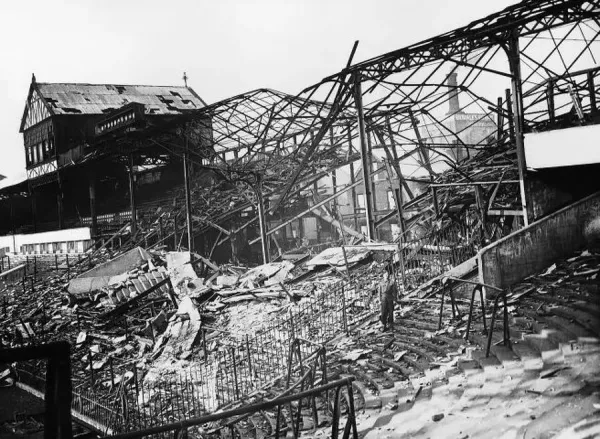
In 1950, football did not restart so much as resume breathing. Across Europe, the war had ended five years earlier, yet its presence lingered everywhere the game tried to re-establish itself. Stadiums were damaged or repurposed, clubs were bankrupt or fragmented, and entire leagues had vanished during occupation, bombing, or political collapse. Football’s return in the early 1950s was not triumphant. It was cautious, improvised, and deeply local.
What mattered was not spectacle, but continuity. The decade became football’s long process of stitching itself back together.
Stadiums as scars
Many grounds reopened before they were repaired. In England, clubs such as Arsenal returned to Highbury, which had been requisitioned as an air-raid station. Old Trafford, heavily bombed in 1941, remained unusable until 1949, forcing Manchester United to ground-share with Manchester City at Maine Road well into the 1950s.
On the continent, conditions were often worse. In Germany, cities like Hamburg, Cologne, and Frankfurt rebuilt football infrastructure alongside housing and transport. Matches in the Oberliga were played in grounds that doubled as rubble clearance sites. Attendance returned not because conditions were comfortable, but because football offered routine.
In Italy, San Siro survived intact, but many provincial grounds did not. Clubs such as Torino, already traumatised by the Superga air disaster of 1949, entered the decade carrying both physical and emotional loss.
Football spaces reflected the societies around them: functioning, but visibly marked.
Leagues rebuilt unevenly
The early 1950s were defined by imbalance. Some leagues recovered quickly; others struggled to exist at all.
In England, the Football League resumed immediately after the war, but the effects of rationing, travel restrictions, and player shortages were still felt into the new decade. Squad depth was thin, pitches poor, and tactical conservatism dominated. Yet the structure endured, giving the impression of stability even when finances were fragile.
In France, the professional league system returned with uncertainty. Clubs such as Stade de Reims, RC Lens, and Lille OSC benefited from industrial backing, while smaller sides collapsed or merged. The league survived, but identity was fluid.
Germany’s situation was more complex. The country remained divided, and football followed political lines. In the West, regional Oberligen became the top level, feeding into a national championship. In the East, the DDR-Oberliga was reshaped under socialist governance, with clubs tied to state institutions rather than communities.
Football did not unify Germany in the 1950s. It mirrored division.
Clubs as social anchors
Clubs mattered because other institutions were weak. In cities still rebuilding civic life, football clubs became gathering points.
In Naples, SSC Napoli drew crowds that reflected hunger as much as loyalty. In Marseille, Olympique de Marseille served as a symbol of working-class resilience in a port city reshaped by war and migration. In Vienna, clubs like Rapid Wien and Austria Wien helped restore a sense of cultural continuity after the collapse of empire and occupation.
Football’s role was not ideological. It was practical. Matches provided structure to weekends. Rivalries gave cities familiar arguments again.
The return of international football
International football resumed slowly. The 1950 World Cup in Brazil symbolised re-entry rather than celebration. Several European nations, including Germany and Italy, arrived with uncertainty rather than confidence.
For some, absence mattered more than presence. England did not participate at all, still ambivalent about international tournaments. Germany returned under restrictions. Spain, politically isolated, remained on the margins.
Friendlies and regional competitions mattered more than global tournaments in the early 1950s. Matches between Austria and Hungary, Italy and Switzerland, or France and Belgium restored cross-border contact gradually.
Football diplomacy preceded political normalisation.
Economic fragility and player movement
The decade opened with financial caution. Transfer fees were limited. Wages were controlled or capped in many countries. Players often held second jobs.
In England, the maximum wage restricted earning potential, reinforcing loyalty but suppressing mobility. On the continent, payment structures varied widely. In Italy and Spain, wealthier clubs began quietly attracting talent, laying foundations for later dominance.
Movement across borders was still rare, but it increased as restrictions eased. Players like László Kubala, who fled Hungary after 1949 and later starred for FC Barcelona, embodied the intersection of football, exile, and politics.
The 1950s turned players into symbols of movement as much as skill.
Football and memory
One reason football survived the post-war period was familiarity. Rules remained unchanged. Rituals persisted. Supporters recognised the game even as everything else shifted.
Yet memory was fragile. Many clubs lost archives, records, and even names during the war. In Eastern Europe, clubs were renamed repeatedly to align with political institutions. In Germany, clubs dissolved and reformed under new regulations.
The 1950s quietly introduced the idea that football history needed preserving. Match reports, photographs, and statistics began to carry greater weight, not out of nostalgia, but necessity.
Football needed proof it had existed before.
A decade of quiet reconstruction
The early 1950s are often overshadowed by later glamour: the European Cup, television, tactical revolutions. Yet without this decade’s slow rebuilding, none of that follows.
Football did not modernise immediately after the war. It stabilised. It returned to cities, routines, and habits. It learned how to function again inside damaged societies.
By the end of the decade, crowds were larger, leagues more secure, and confidence restored. The ruins were still visible, but football had reclaimed its place among them.
The 1950s were not about innovation. They were about survival — and survival, in football, proved transformative.

 By
By
C555 is awesome! I really enjoyed this game and recommend all my friends to try it. The bonuses are awesome and the chances of winning are good. Try it here: c555
If you’re into poker, Luckypkr888 is worth a look. Good traffic, decent software. Maybe you will get lucky! Check it out at luckypkr888.
Just tried out bet123login, and gotta say, the login process was smooth as butter. No annoying glitches or redirects. Straight to the games. Check it out here: bet123login