
A continent that needed comparison
By the early 1950s, European football had rebuilt its domestic routines, but it lacked a shared frame of reference. Clubs dominated locally yet existed in isolation, their reputations built on newspapers, friendlies, and hearsay. There was no accepted answer to a simple question: which club side was the best in Europe?
The decade created the conditions for that question to matter. Improved rail travel, expanding media coverage, and the gradual reopening of borders encouraged comparison. Football culture had become confident enough to look outward again.
The European Cup was the result.
Friendlies, tours, and fragile prestige
Before the mid-1950s, international club football relied on exhibitions. Clubs like Wolverhampton Wanderers, Honvéd, Real Madrid, and AC Milan toured extensively, playing high-profile friendlies that carried symbolic weight.
In December 1954, Wolverhampton Wanderers defeated Honvéd 3–2 under floodlights at Molineux, overturning a two-goal deficit against a team containing Ferenc Puskás, Sándor Kocsis, and József Bozsik. English newspapers promptly declared Wolves “champions of the world”.
On the continent, the claim was ridiculed. In France, L’Équipe journalists Gabriel Hanot and Jacques Ferran argued that football needed structure, not declarations. Prestige required competition, not commentary.
The idea of a continental tournament was no longer theoretical. It was overdue.
The role of L’Équipe and institutional backing
Unlike many football innovations, the European Cup did not originate with clubs or federations. It came from journalists.
Hanot and Ferran proposed a knockout competition between national champions, inspired partly by South American club tournaments and earlier Central European competitions like the Mitropa Cup. Their proposal gained traction because it aligned with a broader mood: Europe was reconnecting, and football could follow.
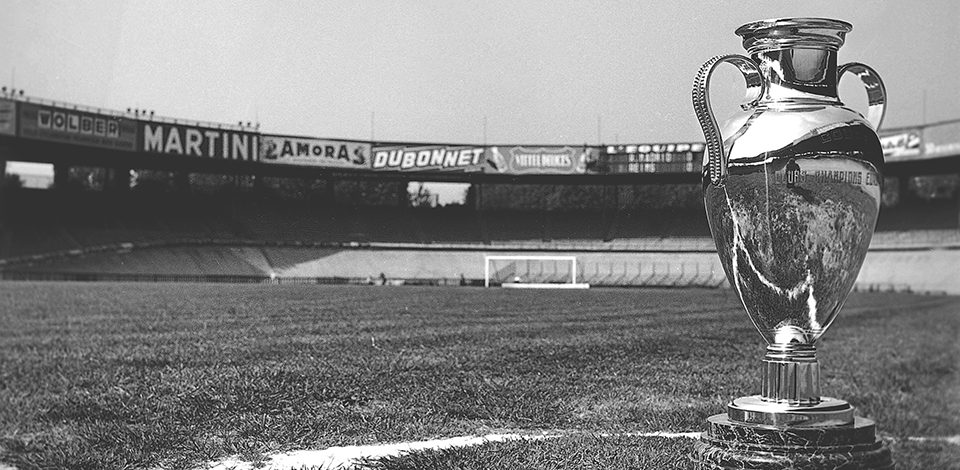
UEFA, founded in 1954, provided the necessary administrative framework. The European Champion Clubs’ Cup was officially approved in 1955.
Importantly, participation was initially voluntary. Some national associations hesitated. Others embraced the idea immediately.
The first participants
The inaugural competition in 1955–56 featured clubs that defined the decade’s football geography.
Real Madrid represented Spain, Stade de Reims France, AC Milan Italy, Hibernian Scotland, Servette Switzerland, Partizan Belgrade Yugoslavia, and Anderlecht Belgium. England, cautious and sceptical, initially nominated Chelsea, then withdrew under Football League pressure.
This absence mattered. The European Cup began without the country that claimed to have invented the game.
The tournament structure was simple: two-legged ties, away goals irrelevant, replays if necessary. Travel was arduous. Budgets were tight. Yet clubs understood the opportunity immediately.
This was not an exhibition. It was validation.
Real Madrid and early dominance
If the European Cup needed a defining figure, it found one instantly.
Real Madrid, led by Alfredo Di Stéfano, Francisco Gento, and later Ferenc Puskás, approached the competition with seriousness unmatched by many rivals. Club president Santiago Bernabéu understood symbolism. Victories were not just sporting; they were political and cultural statements for a Spain emerging cautiously from isolation.
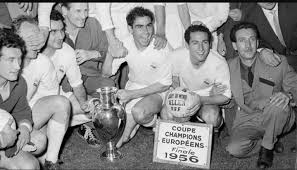
Madrid won the first five European Cups from 1956 to 1960, defeating clubs such as Stade de Reims, AC Milan, Eintracht Frankfurt, and Fiorentina. Finals were staged at Hampden Park, Heysel, and the Santiago Bernabéu itself, turning matches into continental events.
Dominance mattered. It legitimised the competition.
Different motivations across Europe
Not every club entered for the same reasons.
In France, Stade de Reims viewed the European Cup as confirmation of domestic excellence. In Italy, AC Milan and Fiorentina balanced continental ambition with intense league priorities. In Central and Eastern Europe, clubs like MTK Budapest, Red Star Belgrade, and Dukla Prague carried national expectations shaped by political systems that viewed sporting success as ideological evidence.
Travel restrictions, visa complications, and state oversight affected participation unevenly. Yet these challenges increased the competition’s significance rather than diminishing it.
To play in Europe was to be recognised beyond borders.
England’s delayed acceptance
England’s relationship with the European Cup defined the decade’s tension between insularity and adaptation.
After Chelsea’s withdrawal, Manchester United entered the competition in 1956, driven by Matt Busby’s belief that football should be measured internationally. United’s youthful side, the “Busby Babes”, reached the semi-finals in 1957 and 1958, playing adventurous football that contrasted sharply with domestic caution.
The Munich air disaster in February 1958 halted that trajectory brutally. United’s European story became a human tragedy rather than a sporting argument, yet its impact was profound. England could no longer ignore Europe.
By the end of the decade, participation was no longer controversial. It was essential.
Media, memory, and myth-making
The European Cup arrived at the right cultural moment. Newspapers expanded foreign coverage. Radio broadcasts crossed borders. Television, still limited, began capturing finals.
Clubs became recognisable beyond their cities. Players became continental figures. Di Stéfano was not just Real Madrid’s star; he was Europe’s.
The competition created shared reference points. A win in Milan or Madrid meant something everywhere. Football’s geography tightened.
This was not globalisation yet, but it was connection.
Structural consequences
The European Cup altered domestic football subtly but permanently. Clubs prioritised squad depth. Tactical approaches adapted to two-legged ties. Home advantage gained strategic importance.
National leagues began aligning calendars to accommodate Europe. Travel logistics became professionalised. Administrators thought internationally for the first time.
The competition also exposed inequalities. Wealthier clubs adapted faster. Smaller champions struggled with costs. The seeds of imbalance were planted early.
Yet without that imbalance, the competition may not have survived.
Why the 1950s mattered
The European Cup could not have emerged earlier. Pre-war Europe lacked stability. Immediate post-war Europe lacked confidence.
The 1950s provided both. Reconstruction created infrastructure. Cultural reopening created appetite. Football, restored domestically, was ready to compare itself internationally.
The competition did not modernise football overnight. It reframed ambition. Clubs no longer measured success only at home.
By the end of the decade, European football had a centre of gravity. It was not fixed to one nation, but to an idea: that greatness required comparison.
That idea began here.

 By
By