
A genius held together by context
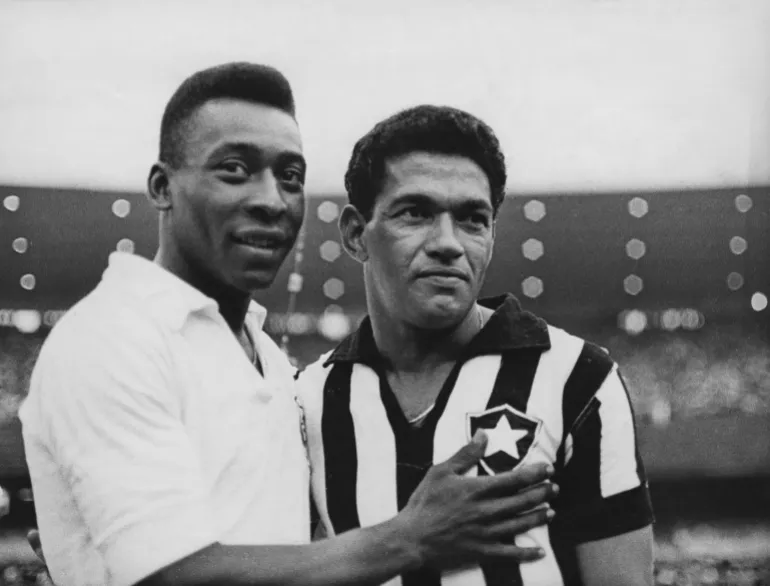
Manuel Francisco dos Santos, known forever as Garrincha, is usually remembered inside a protective frame. Brazil. Botafogo. The Maracanã. Teammates who understood him. A tactical system that tolerated chaos because it delivered goals. Within that structure, Garrincha became untouchable. Outside it, he was exposed.
To ask what Garrincha looked like without Brazil’s protection is to strip away the conditions that made him survivable as a footballer. It means examining moments when he was removed from the environment that absorbed his flaws and amplified his brilliance. It also means understanding how fragile his career always was, even at its peak.
A body never meant for systems
Garrincha’s physical condition is well documented, but rarely examined for its consequences. One leg was shorter than the other. His knees curved inward and outward at opposing angles. Medical logic suggested he should not walk properly, let alone dribble at elite level. Brazil did not try to correct him. They worked around him.
Botafogo built space for Garrincha. Teammates like Nilton Santos and Didi adjusted their positioning so Garrincha could stay wide, isolated, and free. The Brazilian national team did the same. Coaches did not ask him to press, track back, or follow positional instructions. His role was singular: receive the ball and destroy the full-back.
Remove that tolerance and Garrincha became vulnerable. In leagues and teams that demanded discipline, defensive responsibility, or structured movement, his value dropped sharply.
Club football beyond Botafogo
At Botafogo, Garrincha was protected institutionally. The club shielded him from criticism, handled his absences, and accepted his lifestyle. Rio de Janeiro football culture, still semi-professional in practice during the 1950s, allowed stars to exist as individuals rather than employees.
His later club career tells a different story. At Corinthians, Flamengo, and Atlético Junior in Colombia, Garrincha struggled to replicate anything close to his Botafogo form. Training expectations were firmer. Tactical patience was thinner. Physical decline, accelerated by injuries and alcoholism, became impossible to hide.
In Colombia, playing for Atlético Junior in Barranquilla, Garrincha was no longer indulged. The league demanded availability, fitness, and consistency. He delivered flashes, not foundations. Without a system designed around him, his weaknesses overwhelmed his magic.
Brazil as a shelter, not just a shirt
The Brazilian national team did more than select Garrincha. It absorbed him. During the 1958 and 1962 World Cups, Brazil effectively built a parallel structure where Garrincha existed outside conventional responsibility. Zagallo tracked back for him. Didi managed tempo so Garrincha could wait. Full-backs stayed deeper to protect his space.
In 1962, when Pelé was injured, Brazil leaned entirely on Garrincha. He delivered one of the most extraordinary individual tournaments in football history. But even then, he was never alone. The team bent around him.
When Brazil stopped doing that, Garrincha faded quickly. He was selected for the 1966 World Cup in England, but the environment had changed. The pitches were heavier. Opponents were more physical. Tactical tolerance was lower. Brazil itself was no longer willing to absorb everything.
European football and the myth of universality
Garrincha never played in Europe. This absence has protected his legend. European football in the 1950s and 1960s demanded tactical obedience, positional discipline, and defensive contribution from wide players. Wingers were expected to retreat, press, and participate in rigid structures.
Had Garrincha played for a club like Juventus, Inter Milan, or Manchester United, he would have faced constant friction. Coaches would have asked him to defend. Media scrutiny would have focused on his lifestyle. Medical teams would have attempted to “fix” his body.
Brazil did none of that. They understood that Garrincha functioned only if left untouched. Outside that understanding, his career might have collapsed earlier than it did.
Authority, discipline, and control
Garrincha struggled with authority. He missed training. Ignored instructions. Lived without restraint. In Brazil, this was managed quietly. Abroad, it would have been punished.
This matters because football professionalism hardened rapidly during his career. By the mid-1960s, clubs were becoming workplaces. Tactical systems were becoming mandatory. Garrincha belonged to an older football world that was disappearing.
Without Brazil’s cultural tolerance, Garrincha became incompatible with the direction the sport was taking.
The price of freedom
Brazil’s protection allowed Garrincha to be free on the pitch, but it did not protect him off it. The same indulgence that preserved his football also accelerated his collapse. There was no intervention, no rehabilitation, no long-term planning.
When the protection ended, there was nothing underneath. His post-football life was defined by poverty, illness, and neglect. The system that had sheltered him had never prepared him for independence.
In that sense, Garrincha without Brazil’s protection was not just a weaker footballer. He was a man exposed to a world that no longer knew what to do with him.
What Garrincha teaches us
Garrincha challenges the idea that great players are universally transferable. He was not a modular talent that could be dropped into any league, any system, any culture. He was context-dependent brilliance.
Modern football often assumes that talent scales globally. Garrincha suggests the opposite. Some players exist only because a specific environment allows them to. Remove that environment and the talent does not travel intact.
Brazil did not just produce Garrincha. It sustained him.
Legacy without export
Garrincha remains one of football’s purest expressions of individual joy. But his greatness was local, cultural, and conditional. That does not diminish it. It explains it.
Without Brazil’s protection, Garrincha becomes a warning rather than a miracle. A reminder that football’s greatest artists are not always built to survive outside the spaces that understand them.

 By
By