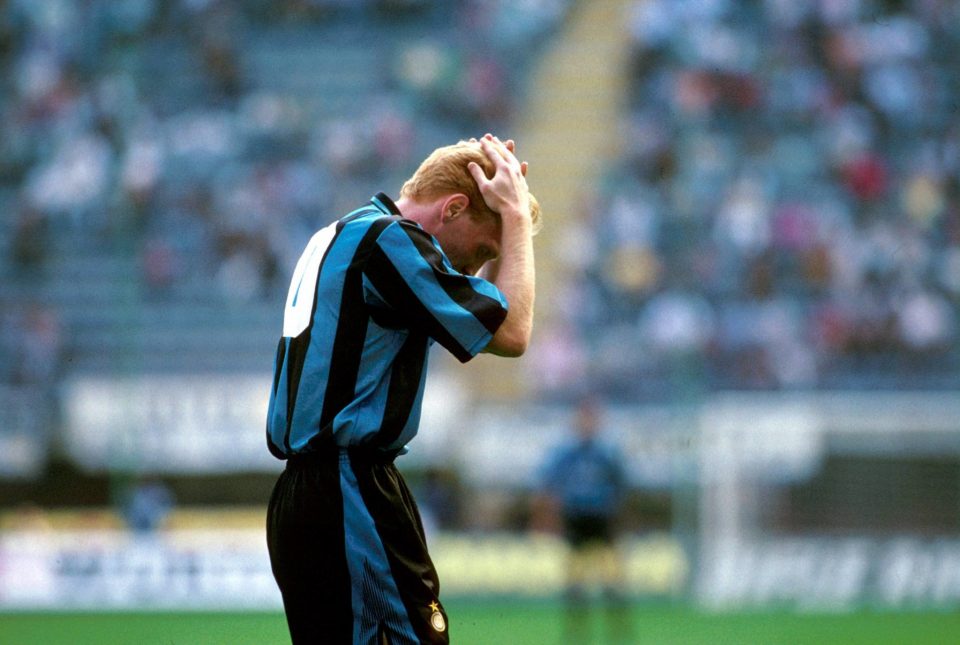

A player shaped by division
Before Euro 1996 turned Matthias Sammer into a continental symbol, he was already a footballer shaped by fracture. Born in Dresden in 1967, Sammer’s formative years belonged to East German football, a system defined by state oversight, physical rigour, and tactical discipline rather than celebrity. Long before Wembley and golden boots, he was a product of Dynamo Dresden, the most powerful club in the DDR-Oberliga, and of a football culture that demanded usefulness before expression.
Sammer did not emerge as a ready-made leader. He emerged as a problem-solver.
Dynamo Dresden and early responsibility
Sammer debuted for Dynamo Dresden in 1985, still a teenager, in a league where youth was tolerated only if it delivered reliability. Dresden, coached by Eduard Geyer, were perennial contenders in East Germany, winning the DDR-Oberliga in 1989 and regularly competing in European competitions.
Sammer initially played as an attacking midfielder, encouraged to use his energy rather than impose authority. The expectations were clear: cover ground, respect structure, contribute goals when possible. He was technically sound, tactically aware, and unusually intense, but he was not yet the dominant figure he would later become.
European matches against clubs like Bayern Munich and AS Roma exposed him early to football beyond the Iron Curtain. These were not just sporting experiences but cultural ones, moments when East German players briefly saw another footballing reality.
East Germany and a disappearing nation
Sammer won his first international cap for East Germany in 1986. By the time he became a regular, the nation itself was nearing collapse. He was part of the final generation of East German internationals, playing during a period when political certainty had evaporated.
In 1990, East Germany played its final international matches before reunification. Sammer was present at the end of a football identity that had existed separately for four decades. When the German Democratic Republic disappeared, so did the structures that had shaped him.
Unlike many East German players who struggled to adapt, Sammer transitioned quickly. The discipline he had absorbed became an asset rather than a burden.
The Stuttgart years
After reunification, Sammer joined VfB Stuttgart in the Bundesliga. This move was not glamorous, but it was crucial. Stuttgart were a competitive, well-run club, and Sammer found a space where his intensity and tactical intelligence translated immediately.
Under coach Christoph Daum, Stuttgart won the Bundesliga in 1992. Sammer scored regularly from midfield, contributing goals while adapting to a faster, more open league. He was no longer just an industrious player. He was becoming central to how teams functioned.
Yet even then, Sammer was not fixed to one role. He oscillated between midfield and attack, still searching for the position that would define him.
Inter Milan and resistance
In 1992, Sammer moved to Inter Milan. On paper, it was a step up. In reality, it was a misalignment. Serie A was at its tactical peak, but also at its most rigid. Inter expected obedience to a system that did not fully accommodate Sammer’s instincts.
Injuries, language barriers, and tactical friction limited his impact. He was not a failure, but he was uncomfortable. Inter’s structure constrained the very qualities that made him valuable: his willingness to step forward, break lines, and impose himself beyond positional limits.
The Italian experience mattered precisely because it did not work. It clarified what Sammer was not. He was not a specialist role-player. He needed freedom within structure, not restriction.
Borussia Dortmund and reinvention
Sammer’s return to Germany in 1993, joining Borussia Dortmund, marked the decisive phase of his pre-1996 evolution. Under Ottmar Hitzfeld, Dortmund offered clarity, trust, and a tactical framework that allowed adaptation.
Initially used in midfield, Sammer was gradually moved deeper. Injuries forced experimentation, but the results were transformative. As a libero in a modernised sense, Sammer could read the game, step into midfield, and dictate tempo. He was no longer chasing influence. He was organising it.
Dortmund won the Bundesliga in 1995 and 1996. Sammer was central to both titles, not just as a defender but as the team’s emotional axis. He communicated constantly, pressed forward when needed, and absorbed responsibility that others avoided.
Germany before the breakthrough
Sammer debuted for unified Germany in 1990, but his international career developed slowly. Coaches experimented with his position, uncertain how best to use him. He was sometimes peripheral, sometimes essential, rarely settled.
Germany in the early 1990s was in transition. The 1994 World Cup ended in disappointment against Bulgaria. Tactical certainty was fading. Sammer, meanwhile, was still evolving, still redefining his role.
By 1995, that uncertainty began to resolve. His performances for Borussia Dortmund forced the national team to adapt to him rather than the other way around.
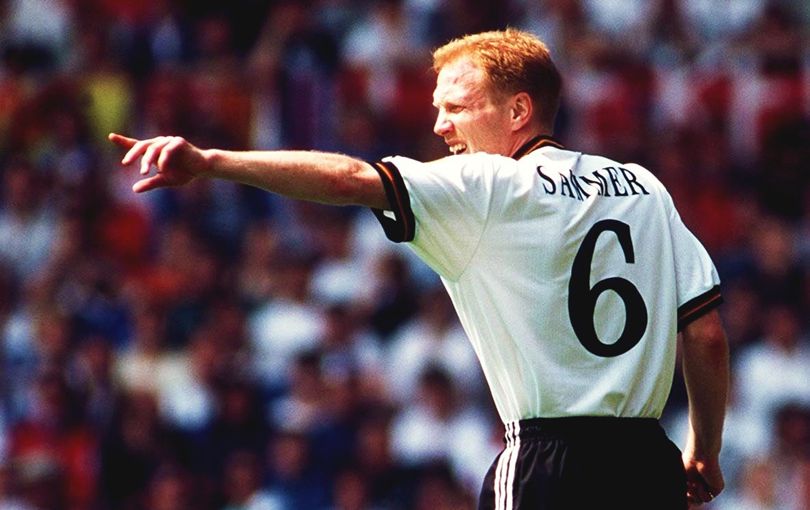
Not yet a symbol
Before Euro 1996, Sammer was respected but not mythologised. He was known as intense, demanding, occasionally abrasive. He was not universally loved. He did not perform with flair. His value lay in control, anticipation, and intervention.
He represented a new type of German footballer: shaped by East German discipline, refined by Bundesliga freedom, tested by Italian rigidity. He carried pieces of multiple football cultures without fully belonging to any single one.
Euro 1996 would turn him into a symbol of German efficiency and leadership. Before it, he was something more complex and less resolved.
The importance of what came before
Sammer’s triumph in England did not emerge suddenly. It was built on years of positional uncertainty, cultural displacement, and tactical adjustment. Without Dynamo Dresden, there is no discipline. Without Stuttgart, no confidence. Without Inter Milan, no clarity. Without Dortmund, no reinvention.
Before Euro 1996, Matthias Sammer was already complete in pieces. The tournament did not create him. It assembled him.

 By
By
If you’re looking for something a little upscale, millonixvip might be your thing. Felt pretty VIP using it. See for yourself: millonixvip
8okslot, not too shabby! Got in some quality time playing these slots. Might just be my new go-to. Swing by: 8okslot
Hey, just tried out qh77 and it’s pretty cool! The games are smooth and I had a decent run. Definitely worth checking out if you’re looking for something new. qh77