
A striker remembered too narrowly
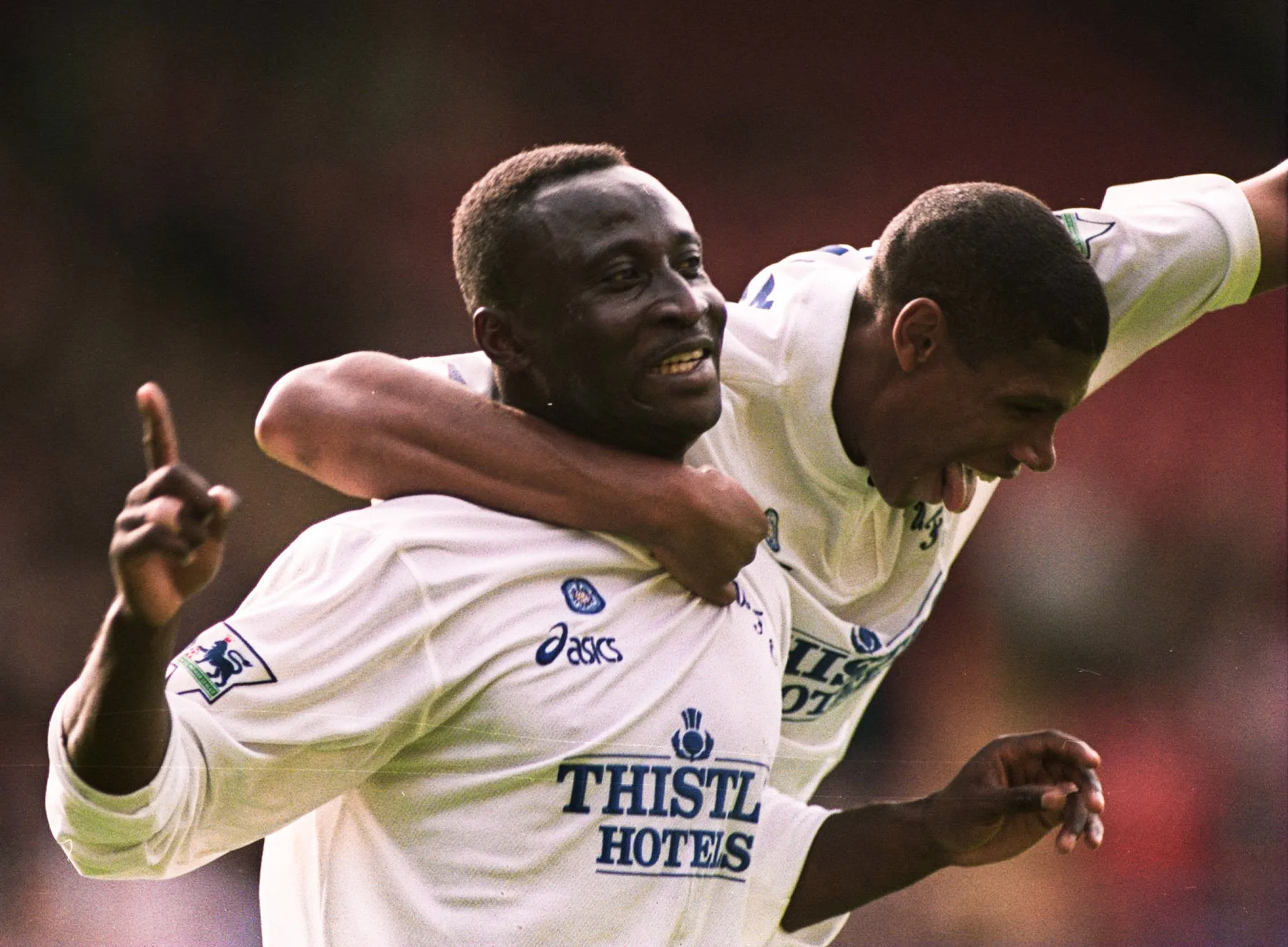
Anthony Yeboah’s name still triggers the same reflex. A thunderous strike. A net shaking violently. A goalkeeper left frozen. His goals for Leeds United are replayed endlessly, reduced to highlight clips that strip away everything else. In the popular memory, Yeboah exists almost entirely in mid-air or mid-volley, defined by two goals that won awards and a reputation for spectacular finishing.
What is often forgotten is that Yeboah’s story is not primarily about beauty or explosiveness. It is about endurance, displacement, leadership, and quiet resistance. He was a foreign striker navigating hostile environments, cultural isolation, and racial abuse, all while carrying the weight of expectation for both club and country. To understand Anthony Yeboah properly, the goals must be set aside, at least briefly.
From Accra to Europe
Anthony Yeboah was born in 1965 in Accra, Ghana, growing up in a football culture rich in talent but limited in opportunity. Like many African players of his generation, his route to Europe was uncertain and indirect. He moved to Germany in the late 1980s, joining Saarbrücken, a modest club far removed from the glamour of elite European football.
Germany was not an easy place for African players at the time. Cultural barriers were high, support systems were limited, and racism was often overt. Yeboah adapted not through flair but through discipline. He learned the physical demands of German football, refined his movement, and developed the strength that would later define his play.
His breakthrough came at Eintracht Frankfurt, where he arrived in 1990. There, Yeboah became more than a striker. He became the focal point of one of the most entertaining teams in Bundesliga history.
Frankfurt and responsibility
At Eintracht Frankfurt, Yeboah reached his true peak. He was not simply a finisher but a leader in a team defined by fluid attacking football. Frankfurt’s side of the early 1990s played with freedom and imagination, and Yeboah thrived within it. He scored consistently, but he also held the line, brought others into play, and absorbed pressure.
Crucially, Yeboah was made captain. This decision carried weight. A Black African player wearing the armband in early-1990s Germany was not common. The responsibility extended beyond the pitch. He represented the club publicly, dealt with abuse quietly, and maintained authority in environments that were not always welcoming.
Frankfurt came close to winning the Bundesliga title, finishing runners-up in 1992. Their failure was narrow, painful, and defining. Yeboah left soon after, not because he had declined, but because opportunities elsewhere called.
Arrival in England
When Yeboah joined Leeds United in 1995, English football was still adjusting to its new era. The Premier League was young, foreign players were increasing, and stereotypes remained strong. Yeboah did not fit neatly into existing categories. He was powerful but technical, direct yet intelligent.
His impact was immediate. Goals followed quickly, including the now-immortal strikes against Liverpool and Wimbledon. These goals won Goal of the Month, then Goal of the Season, then Goal of the Season again. The clips became unavoidable.
Yet Leeds was not Frankfurt. The team was less fluid, the expectations heavier, and the environment harsher. Yeboah faced racial abuse from opposition fans and sections of the media that struggled to contextualise him beyond physicality. He responded by scoring, but also by withdrawing.
Life beyond the highlight reels
Yeboah was not a showman. He did not celebrate extravagantly or seek attention. Teammates often described him as quiet, private, and reserved. This reserve was frequently misinterpreted as detachment or aloofness.
Behind the scenes, Yeboah carried himself with professionalism. He trained hard, maintained high standards, and avoided controversy. When his form dipped, as it inevitably did, criticism arrived quickly. The same media that celebrated his goals often reduced him to a novelty when he stopped scoring spectacularly.
By the late 1990s, Leeds moved on. New systems, new managers, and new priorities pushed Yeboah to the margins. His departure was unceremonious, reinforcing the idea that his time in England had been defined solely by moments rather than substance.
Ghana and national duty
While club football brought visibility, Yeboah’s relationship with the Ghana national team was more complex. He earned over 50 caps and captained the side, representing his country during a transitional period. Ghana was rich in talent but inconsistent in structure, and international tournaments were often marked by internal tension.
Yeboah was not always celebrated at home. Expectations were enormous, and failures were personalised. Despite this, he remained committed, leading the team and scoring important goals. His leadership extended beyond football, as he became a bridge between European professionalism and African football culture.
In later years, Yeboah served in administrative roles within Ghanaian football, advocating for better structures and player support. This aspect of his career rarely enters mainstream discussion, yet it reflects a deeper commitment to the game.
Decline without spectacle
Yeboah’s decline did not produce headlines. He moved through Hamburg, then returned briefly to Frankfurt, before retiring quietly. There were no farewell tours or tributes. His career ended as it had often been lived, away from the spotlight.
This lack of ceremony contributes to how he is remembered. Without ongoing presence or controversy, his story faded into clips and nostalgia. Younger fans know the goals but not the context.
Yet his longevity, consistency, and adaptability across leagues deserve recognition. He succeeded in Germany and England at a time when African players were still treated as exceptions rather than norms.
A different kind of influence
Anthony Yeboah did not change football tactically, but he altered perceptions incrementally. He showed that African forwards could lead teams, captain clubs, and succeed in structured European systems without abandoning their identity.
His professionalism set standards quietly. Players who followed, particularly from West Africa, entered environments slightly more prepared, slightly more accepted. That progress was slow and uneven, but it mattered.
Yeboah never positioned himself as a symbol. Others did that for him, often unfairly. His preference was always to let performance speak.
Why he deserves more
Anthony Yeboah deserves to be remembered as more than a compilation. His goals were extraordinary, but they were not isolated miracles. They were the product of intelligence, timing, and confidence developed over years of adaptation.
He navigated racism without spectacle, leadership without applause, and success without myth-making. In an era increasingly obsessed with narrative extremes, his story sits awkwardly between heroism and understatement.
That is precisely why it belongs on the margins of football history, where the full picture can be seen. Beyond the goals, Anthony Yeboah’s career offers a quieter lesson: that greatness does not always announce itself loudly, and that influence often lingers long after the noise fades.

 By
By