
A national stadium with shrinking meaning
Long before the night of May 1985 fixed Heysel Stadium in football’s collective memory, the ground in Brussels was already a symbol in decline. Built for the 1930 World Cup, Heysel had once represented Belgium’s arrival on the global football stage. By the 1970s and early 1980s, however, it had become an uncomfortable relic — oversized, under-maintained, and increasingly unsuited to the football it continued to host.
To understand why Heysel became the site of catastrophe, it is necessary to look at what the stadium had become before 1985, not only what happened during the European Cup final between Juventus and Liverpool.
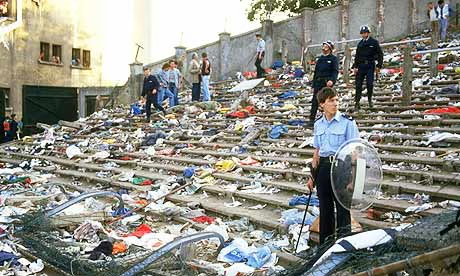
From World Cup showcase to multipurpose shell
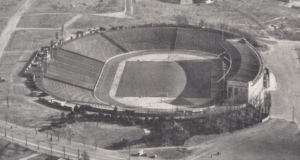
Heysel opened in 1930 as the Stade du Centenaire, constructed to mark Belgium’s centenary and to stage matches at the first World Cup held outside South America. It hosted games involving Belgium, France, Brazil, and Argentina, and at the time it was among the most modern stadiums in Europe.
But unlike grounds such as Wembley or San Siro, Heysel was never allowed to evolve properly. It became a multipurpose venue: football, athletics, cycling, concerts, exhibitions. The running track remained, distancing spectators from the pitch. Terracing aged. Concrete cracked. Renovation was postponed repeatedly.
By the 1970s, the stadium was large but hollow — impressive on paper, uninspiring in reality.
Belgian football’s uneasy centre
Heysel served as the regular home of the Belgium national team, even as club football in the country fragmented. Matches involving RSC Anderlecht, Standard Liège, and Club Brugge in European competition were often staged elsewhere, but cup finals and internationals returned to Brussels out of tradition rather than suitability.
Supporters complained quietly. Facilities lagged behind those in Germany, Italy, and England. Policing relied on outdated assumptions about crowd behaviour. Segregation between rival supporters was minimal. The stadium functioned on the belief that football crowds could still be managed as they had been in the 1950s.
That belief was already outdated.
European finals without European standards
Despite its condition, Heysel continued to be awarded major fixtures. It hosted European Cup finals in 1958, 1966, 1974, and 1985. Each time, visiting supporters encountered the same problems: poor signage, inadequate access routes, crumbling terraces, and limited facilities.
The 1974 final between Bayern Munich and Atlético Madrid passed without major incident, but even then concerns were raised internally about safety and infrastructure. Those warnings did not translate into structural change.
Heysel remained a prestigious address largely because Belgium had not yet offered a modern alternative.
The changing nature of football crowds
By the late 1970s and early 1980s, football culture across Europe was changing. Support became louder, more mobile, and in some contexts more confrontational. English clubs like Liverpool, Leeds United, and Manchester United travelled with large, organised away followings. Italian clubs such as Juventus, Roma, and Napoli brought politically charged ultra groups.
Heysel was not adapted to this reality. Its fencing, walls, and access points belonged to an earlier era. Crowd control depended heavily on static policing rather than dynamic management. Emergency planning was minimal.
The stadium had not become dangerous overnight. It had simply failed to keep up.
A venue chosen by inertia
When Heysel was selected to host the 1985 European Cup final, the decision was driven more by habit than evaluation. Brussels was accessible. Belgium was seen as neutral. UEFA trusted familiarity.
What UEFA did not sufficiently account for was the combination of rival supporter cultures, decaying infrastructure, and a ground ill-suited to modern crowd management. The warning signs were structural, not situational.
Heysel was already failing long before supporters entered the stadium.
The absence of urgency
Perhaps the most striking feature of pre-1985 Heysel was the lack of urgency around its condition. Reports existed. Concerns were voiced. Yet renovation was endlessly deferred. Responsibility was dispersed between municipal authorities, football federations, and event organisers.
Heysel survived on reputation while quietly deteriorating.
What Heysel represented before tragedy
Before 1985, Heysel was not remembered with fear. It was remembered with indifference. It was a stadium people tolerated rather than admired, used because it was there rather than because it was suitable.
That indifference proved fatal.
Why the pre-1985 story matters
The Heysel disaster is often framed as a singular moment of violence and collapse. But the conditions that made it possible were long established. Understanding Heysel before 1985 is not about assigning blame retroactively; it is about recognising how neglect, complacency, and outdated thinking accumulate.
The tragedy did not begin on one night. It began decades earlier, in concrete left to crack and standards left unchanged.


 By
By