
A game without a stage
Before the J-League launched in 1993, football in Japan existed without a national spotlight. It was played seriously, organised carefully, and supported quietly, but rarely celebrated. The sport lived in company grounds, university fields, and regional stadiums far from television cameras. For decades, Japanese football functioned as an amateur and semi-professional ecosystem built on corporate loyalty rather than public spectacle.
This was not a vacuum. It was a different football culture, shaped by post-war reconstruction, industrial sponsorship, and a belief that sport should serve society rather than dominate it.
Corporate teams, not clubs
For much of the 20th century, elite Japanese football revolved around company teams. Corporations such as Mitsubishi, Yamaha Motor, Hitachi, Toshiba, Furukawa Electric, and Nissan Motors ran teams as part of their corporate identity. Players were employees first, footballers second.
Mitsubishi Heavy Industries SC, for example, would later become Urawa Red Diamonds. Yamaha SC evolved into Júbilo Iwata. Nissan Motors FC eventually transformed into Yokohama F. Marinos. These teams trained after work, travelled under corporate banners, and competed with discipline rather than flair.
The idea of an independent football club, detached from an employer, barely existed.
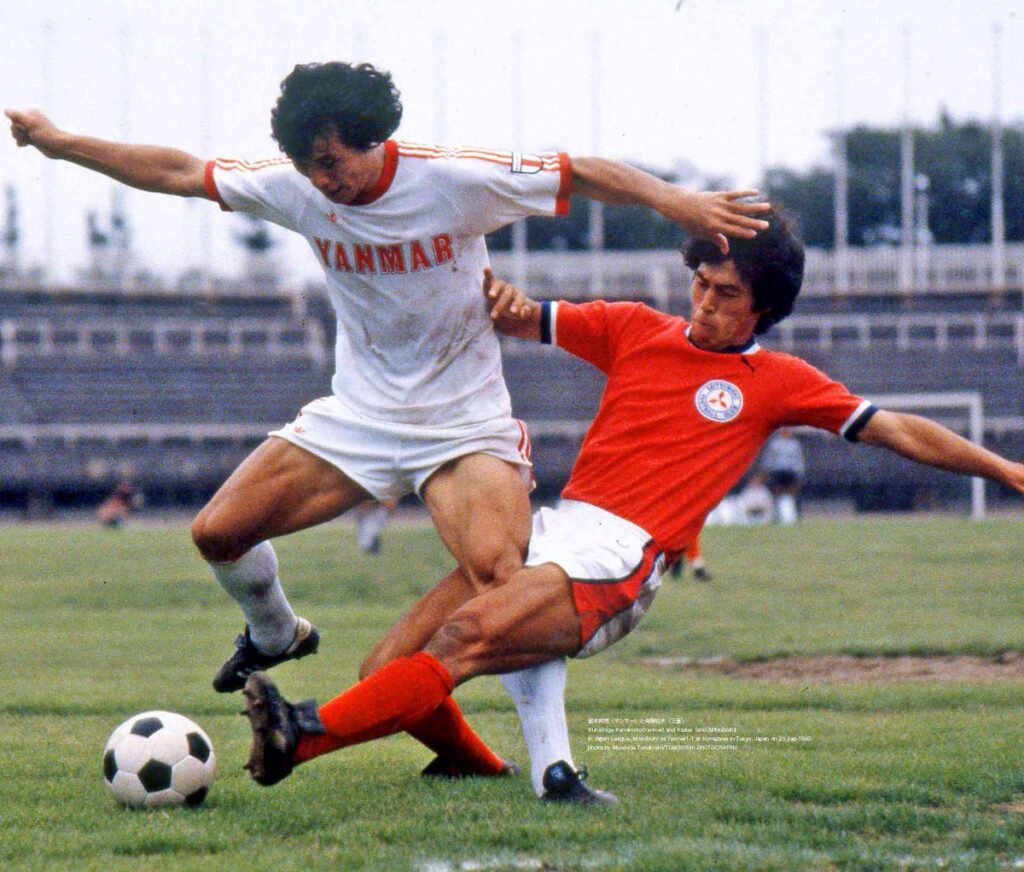
The Japan Soccer League era
Established in 1965, the Japan Soccer League (JSL) became the country’s top competition. It introduced promotion and relegation, national structure, and a level of consistency Japanese football had lacked. Yet it remained resolutely amateur.
Matches were attended by colleagues, families, and local enthusiasts. Crowds were modest. Media coverage was minimal. There were no transfer fees in the modern sense, no agents, no spectacle-driven scheduling.
Still, the JSL mattered. It created a footballing elite, produced national team players, and quietly raised standards.
Universities and the long path up
Unlike Europe or South America, Japan relied heavily on universities to develop players. Institutions like Waseda University, Meiji University, and Hosei University became football incubators. Young players often peaked academically before peaking athletically.
This delayed pathway produced intelligent, disciplined footballers but limited early exposure to elite competition. Many players entered the national team with relatively few high-intensity matches behind them.
It was a system designed for stability, not acceleration.
International isolation
Japanese clubs rarely played international opponents. Asian competition was limited and irregular. The Asian Club Championship existed, but participation was inconsistent, and success rare.
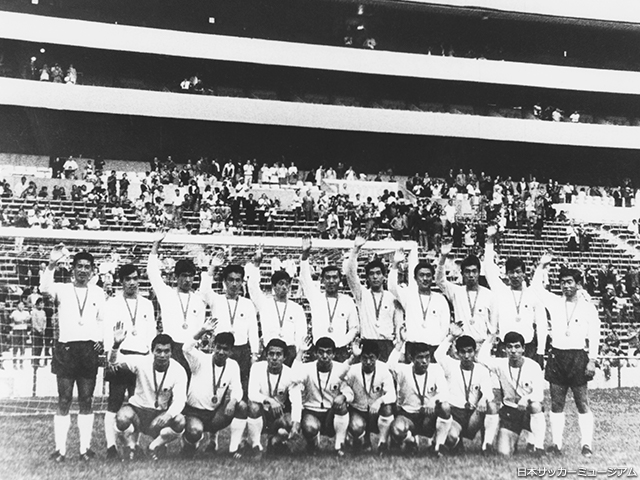
The national team suffered similarly. After qualifying for the 1968 Olympics and winning bronze in Mexico City — still one of Japan’s most significant football achievements — progress stalled. World Cup qualification remained elusive. Matches against South Korea, China, and Iran highlighted the gap between organisation and intensity.
Japanese football was respected for its structure, but not feared.
A style still searching for itself
Tactically, Japanese football before the J-League leaned toward conservatism. Emphasis was placed on fitness, shape, and collective responsibility. Individual expression was secondary. Dribblers were rare. Creative midfielders were constrained.
Foreign influence was limited. There were few imported players and almost no foreign coaches. The game evolved inwardly, without regular reference to European or South American trends.
It produced solid teams, but rarely unforgettable ones.
The missed World Cup and the breaking point
The failure to qualify for the 1990 World Cup in Italy proved decisive. Despite years of incremental improvement, Japan fell short again. For administrators, the message was clear: the existing system had reached its ceiling.
Crowds were not growing. Media interest was stagnant. Talented athletes were choosing baseball instead. Football needed reinvention, not refinement.
The answer was professionalisation.
Preparing the J-League
The creation of the J-League was not sudden. It was planned meticulously throughout the late 1980s. Corporate teams were encouraged to detach from parent companies, adopt regional identities, and invest in stadiums and youth systems.
Cities like Kashima, Iwata, Yokohama, and Hiroshima were selected not for market size alone, but for local commitment. The league would be small, controlled, and culturally embedded.
This was football as social engineering.
The end of the old world
When the J-League kicked off in 1993, it did more than launch a new competition. It ended an era. Company teams faded or transformed. Amateur structures receded. Football moved from factory grounds to floodlit stadiums.
The pre-J-League world disappeared quickly, leaving little nostalgia. Yet without it, the modern game in Japan would not exist.
Why the pre-J-League era still matters
Japanese football before the J-League shows that development does not always follow glamour. It can be slow, corporate, disciplined, and almost invisible — until conditions demand change.
The success of Japan at later World Cups, the export of players like Hidetoshi Nakata, Shinji Kagawa, and Keisuke Honda, and the stability of the J-League all rest on foundations laid quietly decades earlier.
This was football without fame, building a future it could not yet imagine.

 By
By